Back to 
Back to

October 6, 2022
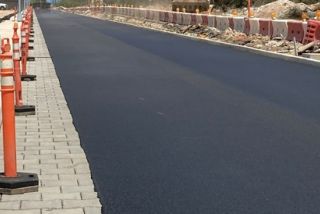
Driving through Kalaeloa, commuters may not notice the innovative technology lining the newly reopened Franklin D. Roosevelt Avenue, near the site of the future Daniel Kahikina Akaka Department of Veterans Affairs Community-Based Outpatient Clinic. The block-like pavement that outlines the new roadway is actually a game-changing concept to address stormwater on roadways. The system is already being used effectively in the continental U.S.
The drainage system combines a permeable pavement called PaveDrain with an underground stormwater detention system called R-Tanks, in place of regular storm drains currently used throughout the City and County of Honolulu. The technology prevents roadway ponding by allowing stormwater to seep through the pavement and into an underground stormwater storage system.
Tony Gaston, vice president of development for Hunt Companies Hawai‘i, highlighted Hunt’s groundbreaking improvements during a City and County of Honolulu Stormwater Quality Workshop in August.
“The permeable pavement and underground storage system is an innovative way to address drainage,” Gaston explained. “This technology helps to reduce stormwater runoff and improve water quality, while at the same time providing a long-lasting surface that is still usable.”
The permeable pavement will line both sides of approximately 5,600 linear feet of new and improved roads being built in Kalaeloa, and stormwater will feed into new retention basins designed by Hunt’s engineering team.
“The PaveDrain system makes it look like an upscale road in an upscale community,” Gaston said.
Hunt has been working collaboratively with city departments in the process. They were able to observe installation of both the permeable pavement and underground storage systems and witness how they work firsthand.
Maintenance will eventually require some manpower. One person would be able to “vacuum” debris from the pavement, if needed, with a vacuum truck. However, Gaston admits, the system will need some time to adjust to the landscape.
“These blocks, they’re going to move a little bit in the beginning, in the first three months or so,” Gaston said. “Once it gets all consolidated, it’s going to be set for good, and by the time the city is willing to take it, it’s going to be sturdy. At the end of the day, the ultimate goal is to keep Hawai‘i’s waters clean.”